
Boost your little one’s attention with these toys
Here are my top toy recommendations to increase the duration of your little one’s attention and their ability to shift focus.
The fact that you are here means you probably already know how important attention and listening skills are for learning all skills. If you want a bit more information, check out my previous blog post here.
So let’s dive into how to support these skills…

What does ‘good attention’ look like?
We want to know that what we are doing actually makes a difference to children’s attention and listening skills. In order to do that we need to know what we are measuring. There are a few measures we can use but to make it easy here are the top 2 I look for as a speech therapist when working with and supporting little ones.
Duration. We are looking for children to be able to focus on an activity for 2-3 minutes x their age (e.g. a 2 year old should be able to focus for 4-6 minutes).
Shared attention. We are looking for little ones to share attention with us, by this I mean focusing on the same thing as us. We know they are doing this when they look in the direction we are pointing or looking, or they turn towards us and back to an object to check we are focusing on what they are doing.
Give me the good stuff! What toys can I use?!
Here are my top toy recommendations to increase the length of time your little one can focus for…

This one is for children with emerging attention skills. So this is for you if your little one flits from activity to activity or they get in the zone with their own play and it is difficult for you to share focus with them.
If that sounds like your little one, look for short. Sharp. Toys that have a sensory element to them. A bag of spinners like these ones, or spinning tops that light up can be great. This is because you can do one after the other, and while the spinner itself may only last a few seconds, by the time you have sequenced through a few, your little one has stayed focused on the activity for a number of minutes.
To make the most of this tip you will want to have a bag/ box of these toys to hand, so you can do one-after-the-other and don’t have to break the flow (trust me, I’ve been there rummaging around trying to find the next toy and by the time I emerge my little learner has moved on!).
Emerging attention toys:
Noisy shape sorters Dinosaur ball popper Balloon Car Click clack track
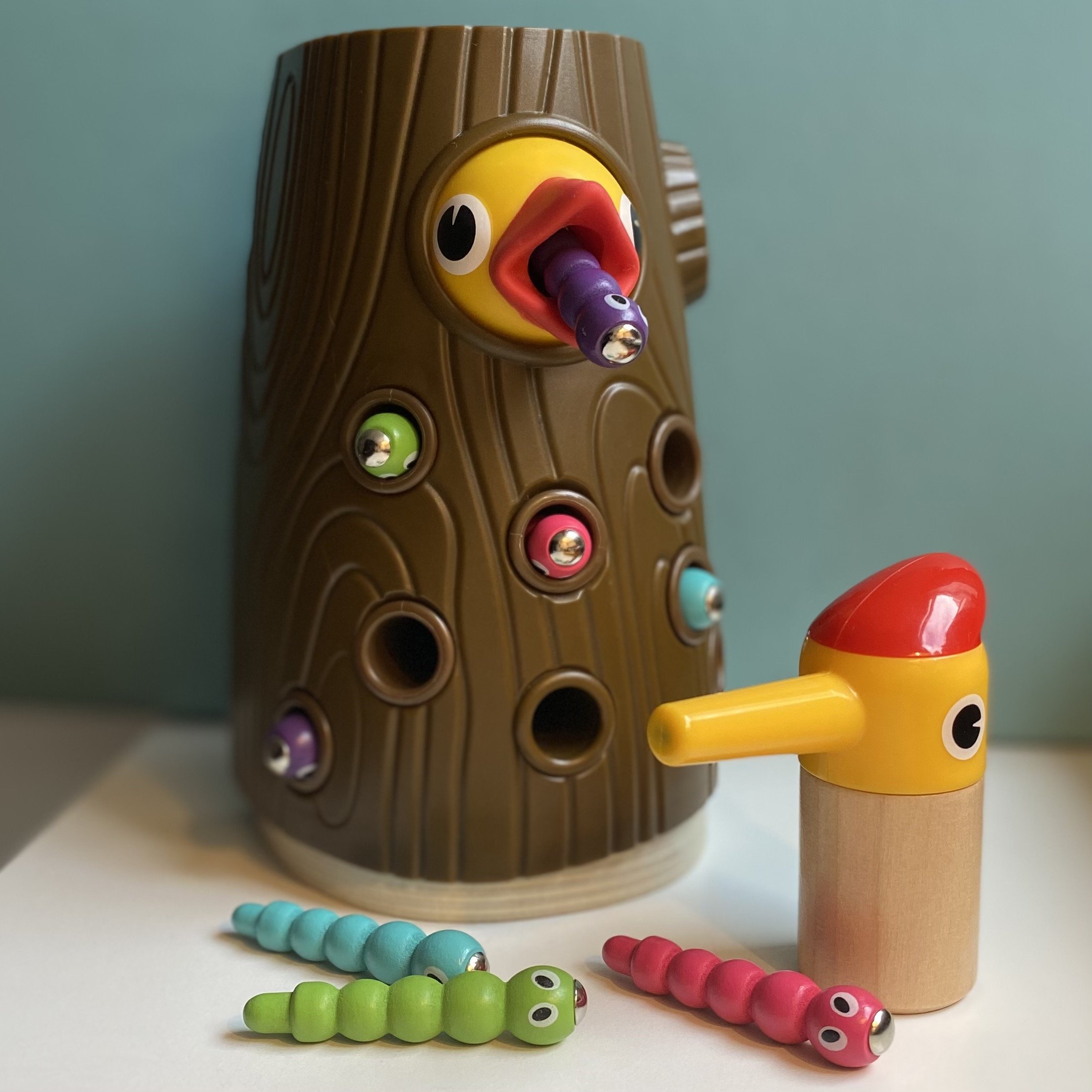
These toys are for children with more established attention and listening skills. Maybe your little one is turning to their name, maybe they are looking at you when they are playing, but perhaps this isn’t happening yet with other children and they can still sometimes flit from toy to toy.
If this sounds like your little one then turn taking toys are the way to go. Shared attention and focus is built into these toys, and they teach the skill of sustaining focus even when we aren’t doing (waiting your turn!).
If this is the first time you are trying a toy like this I recommend building up to playing it ‘properly’. When I introduce turn taking games, I usually take my turn every 3-7 times my little learner has their turn. Gradually I build this up until we each take our turn every other time.
Turn taking toys:
Pop-up T-rex Monkey drop Jitterbug fishing Smelly Wellies
*Some links are affiliate links, which means if you click through and purchase I will earn a small commission

Want to help your little one with speech delay? Start here…
Knowing where to start if your little one is struggling with their understanding or talking.
There are so many components that make up an effective communication which can make it hard to know where to start. If your little one is finding talking or understanding tricky, then a good place to start is attention skills, here’s why…

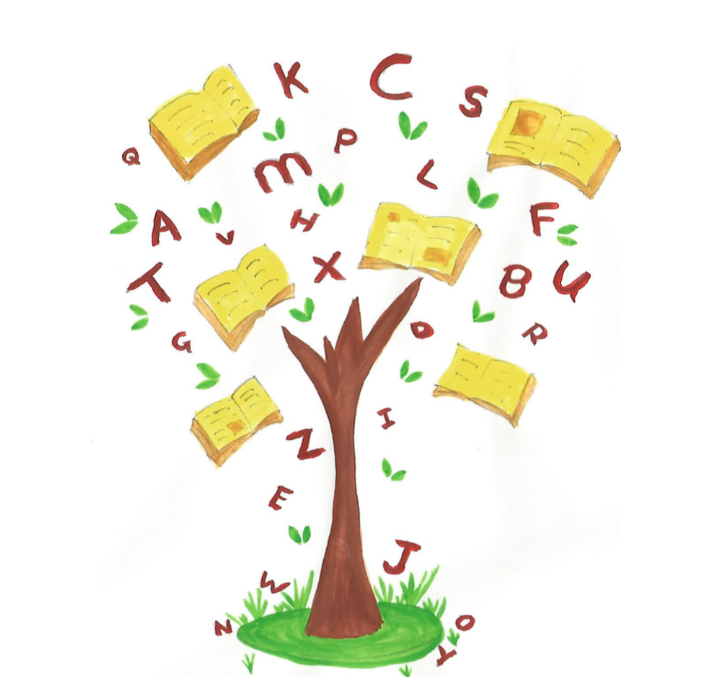
The Communication Tree (Communication Pyramid)
As you can see there are so many elements that contribute to effective communication. Attention and listening skills are the roots/ foundations of communication. Talking and speech sounds are the final components (the leaves).
If you want to learn more about the difference between speech and language skills - check out this blog post.
Why work on attention if my child’s “issue” is with talking?
You can get other skills ‘for free’.
By working on attention skills we often see progress in other skills higher up the tree ‘for free’ (i.e. without actively working on them). This is because attention skills are foundation skills for all other elements of communication.
Speech & language activities require good attention.
When working on speech sounds or language skills with little ones we require them focus for extended periods of time. The activities to develop these skills require good attention and listening skills. That’s not to say that we can’t work on these areas of communication if little ones struggle with their attention, but that they will be able to get the most from the activities if their attention skills are as strong as possible. So it is worthwhile spending the time developing these skills to get little ones in the best place possible to access the activities.
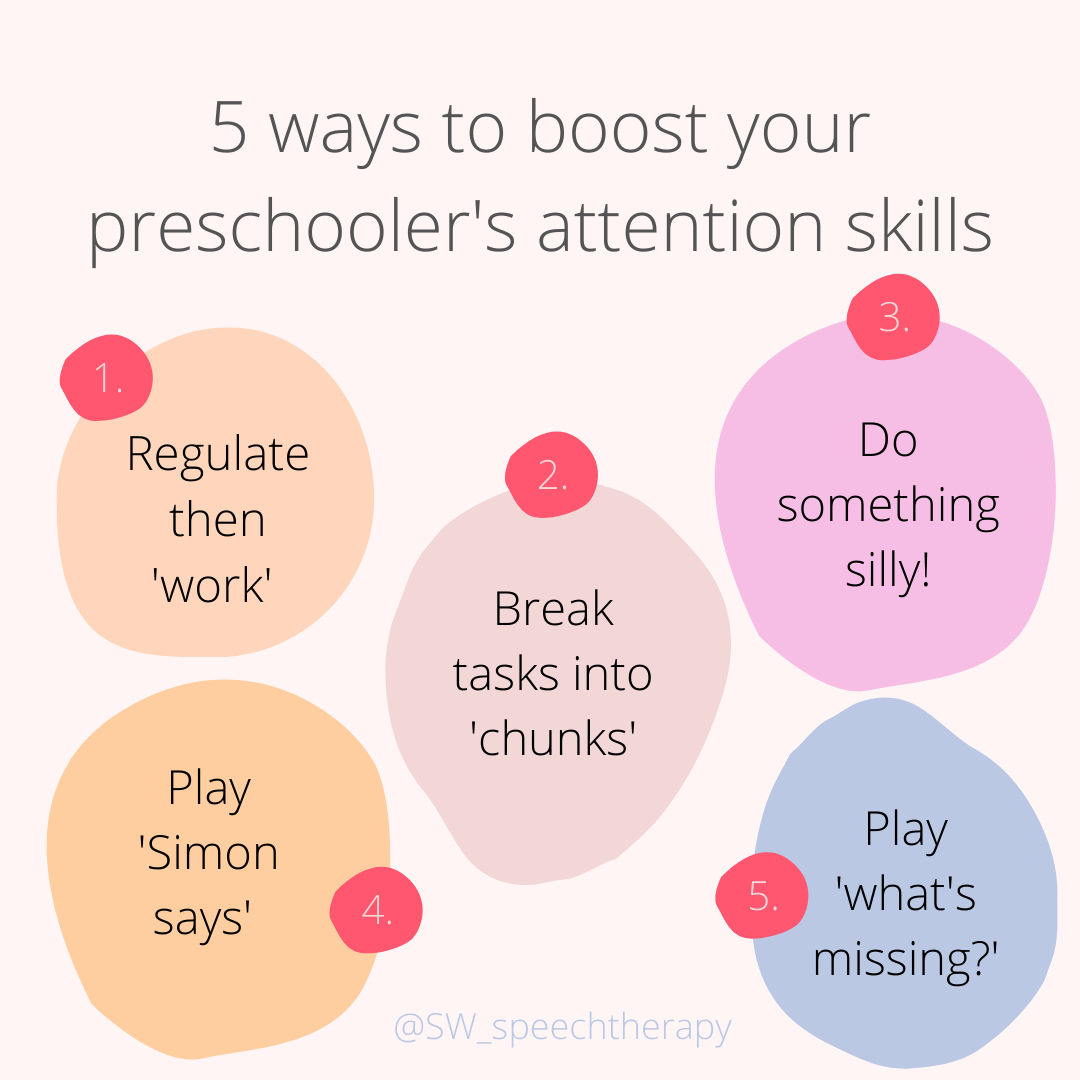
If these tips apply to your little one, check out my instagram for suggestions and activities to boost attention skills: @sw_speechtherapy.

Top tips to make transitions easier for your preschooler.
How to help your little one avoid a meltdown when they are transitioning between activities.

“My little one really struggles with transitions, do you have any tips?” Parent via sw_speechtherapy instagram page.
This is a question I get asked all the time! You are not alone. So many children struggle with transitions, I would even say adults struggle with transitions!
For the most part we can understand why. You’re minding your own business watching Encanto for the 487th time (tell me it’s not just me) and suddenly it comes to and end and you have to do something boring instead. It makes sense that your little one would do all in their power to stop that from happening.
Whilst there are times when your little one can choose exactly what happens in their day, the reality of life is that we don’t get to dictate everything that happens and we need to prep little ones for this.
Why are transitions hard for children with communication differences?
We will dive into the “what to do about it” in a moment but first I want to highlight the main reasons that transitions are challenging. The support we put in place will differ depending on the reason the transition is tricky.
I don’t understand what is happening.
I like familiarity and ‘sameness’.
I don’t want my favourite thing to end.
I am unwell/ something else is going on.
It is likely your little one may be struggling with transitions for multiple reasons, if you aren’t sure which one it is - then assume it’s all of them and work through the strategies below. The main thing to know is that, whenever possible we want to be proactive as opposed to reactive. We want to try and prep before hand to reduce the likelihood of the difficulty occurring.

I don’t understand what is happening
It makes sense that little ones have a meltdown if they don’t understand what is happening. They feel scared and unsure, and understandably want to stick with what they know. Here’s what you can do to support your little one:
Use visual supports to supplement your language and make it clearer what you mean:
Give a warning when something is finishing and set a timer to give a visual clue.
Now-next boards to show what your little one is currently doing and what is coming up next.
Show photos on your phone of what’s coming next. This is a low-prep easy way to show children what to expect.
Be consistent. This one is really, really hard. But if we say we are going to do something we need to do it. Even if it’s inconvenient! If understanding is tricky we need to show children what words mean by our actions. If when we say “we will go to the park” but then we don’t, how can we expect them to learn the work “park”.

I like ‘sameness’
Let me say at the start, if this one rings true for your little one then the road to easy transitions can be a bit longer. It is however, so worth it.
I also want to state that of course little ones are allowed to have preferences and favourites. This strategy is not about abolishing that, but about enabling them to cope with change and variety and seeing it as fun not scary.
Here’s what you can do if your little one has a strong preference for familiarity & sameness:
Gently introduce some small changes into their daily routine
If they love bubbles, buy a different coloured bubble wand and use that occasionally.
Play a short clip (5-30 seconds) of a new episode of their favourite TV show before switching to their fave.
Change the colour of the laces on your shoes.
Introduce a new bath toy with no pressure for them to play with it, but just have it in the bath.
Increase the number of small changes that you are exposing your little one to, try to make some of the changes a really positive change (e.g. make the bubble wand a wand which blows multiple bubbles, make the bath toy a character they really like), and some of them a neutral change (e.g. changing the colour of something).
Over time slowly increase the number of small changes you are making or the importance of the changes (this needs to be built up over time) e.g. take a slightly different route to nursery, toy rotation, draw some chalk shapes on the patio, give them their lunch on a different plate.
These strategies will not instantly change your little one’s ability to cope with transitions but what you are doing is building stamina and resilience to change which ultimately is what a transition is.

I don’t want it to end!
Another one I think we can all relate to! I can certainly! This may be your little one if you have tried the timer strategy and it doesn’t make a difference - it’s not the lack of understanding that’s causing the issue it’s the fact that something really fun is ending.
If this is the case, here’s what you can do:
Have an exit strategy! This is something I talk about in my parent training course where I ask parents to create a super fun engaging ‘box’ for their child full of toys they love. We know that when it is time to put it away it’s going to be hard. So plan ahead and have an exit strategy.
Have their fave snack ready to go as soon as their preferred activity ends.
Transition to another preferred activity.
Use a transition tool. To make the action of transitioning easier can you use a game/ video/ app/ tool during the transition (it is really important that you introduce the tool just before the transition & any associated protest starts).
Watching a video while they move from one thing to the next.
Blowing bubbles while they walk to the next activity.
I’m unwell/something else is going on
This one is likely to be the case if there has been a change in your little one. If they previously were fine with transitions but suddenly it’s hard. Here’s what to do if you notice a sudden shift:
General check, do they have a temperature? Can you see a rash? Are there other signs they may be ill? Consider calling your GP.
Make notes - record when the changes occurred and what they look like. Include any other differences you notice.
Gather information - has anyone else noticed any changes in your little one? What have nursery noticed?
I hope these tips have been helpful, for more advice, tips and tricks follow me on instagram @sw_speechtherapy or sign up to my monthly newsletter!
Some links are affiliate links which means if you choose to purchase an item using that link I will earn a small commission.