3 ways to use play-doh to help your child communicate

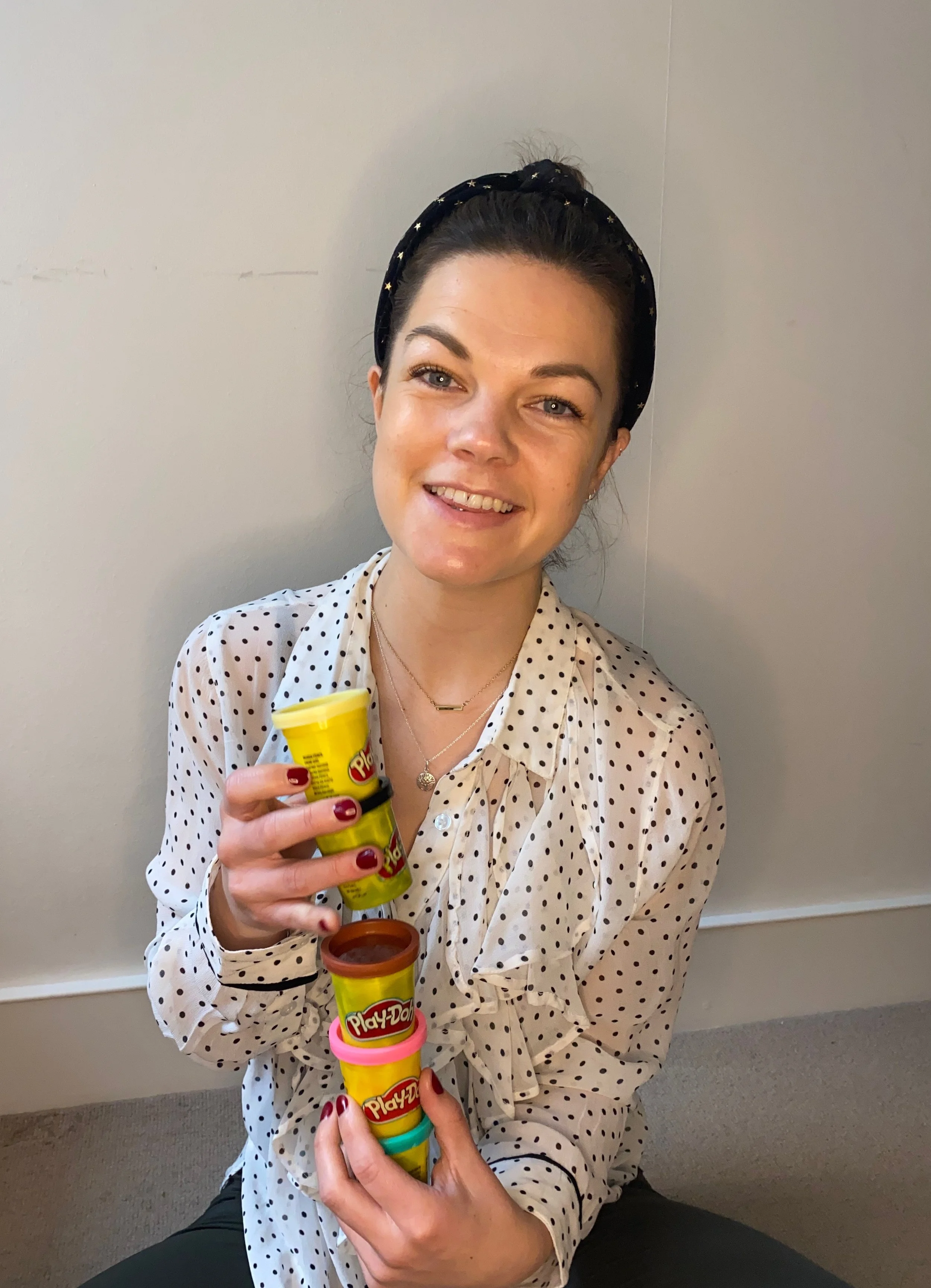
I am often asked how to use different toys to support communication skills. So I thought I would share my top tips for using everyone's favourite messy play toy... play-doh!
Whether you have the brightly-coloured shop-bought or home-made stuff these tips work just as well!
Support play skills through modelling!
Not the type of modelling we usually associate with play-doh, but simply acting out the play scene for your little one and then pausing allowing them time to imitate should they wish to.
This strategy works well if your little one has difficulty generating new ideas within play, and gets stuck on the same play routines over and over again.
Make a play-doh monster!
Make play-doh cookies/ cakes/ salad!
Make a play-doh road and drive/ walk your little one’s favourite toys across it making different tracks.
Develop vocabulary through commenting!
While your little one is playing, comment/ label what they are doing using short phrases (long sentences are too overwhelming!). Try to model a variety to different words…
Adjectives (e.g. size, shape and colour vocabulary)
Positional language (e.g. in, on, under, next to)
Actions (e.g. roll, squeeze, push, open, cut, bake)
Expand your little one’s language and recall skills!
Expand your little one's language by recapping what you did whilst playing with the play-doh. Take photos while you play, and talk about them later.
If your little one says 1-2 word phrases: Repeat the language you modelled during play, while looking at the photos together (e.g. point to the picture and say "roll play doh")
If your little one is saying sentences: Show them the photos and talk about what happened using sentences (e.g. "you rolled the play-doh, you made a cookie").
*some links are affiliate links which means if you click through and choose to buy I earn a small commission.

9 Lessons I’ve learnt in 9 years as Speech & Language Therapist
9 lessons in 9 years as a SLT, what I’ve learnt as a speech and langauge therapist in 9 years practicing.
This month marks 9 years since I graduated from UEA with a Bsc in Speech and Language Therapy!

9 years of notes, assessments, therapy sessions, supervision meetings, training courses, 100s (if not 1000+) of clients, 6 house moves (hello living in London in your 20s!), breakups, new relationships, laughter, tears and many, many brunches (again, hello London)!
I am at the stage now where things are shifting again, I am expanding - taking on therapy assistants to help deliver more, cost-effective therapy for families across South-West London.
Here are the 9 lessons that got me here…
You will have therapy sessions that go horribly wrong, but it won’t always feel so hard.
I had a parent ask me the other day “when was the last time you had a bad session?” the honest answer is that ‘bad sessions’ happen very infrequently these days. Although, to an outsider, a session may look ‘bad’, however to me it is simply an opportunity to learn and adapt. Of course as you develop across your career you improve your skills as a therapist but one of the main differences is mindset, confidence and the ability to be flexible and adapt at the drop of a hat!
It’s ok if it takes you a while to find a setting/ client group that feels like a good fit.
I almost gave up with speech therapy after struggling to find a setting and client group that felt like the right fit for me. So if this feels like you, hang in there! It might not be the profession that’s not working for you, perhaps it is just the role you are in at the moment.
Always be kind to admin assistants and receptionists - they are angels!
This is something people always tell you, and it’s so true! Assistant/ receptionist are often undervalued and under appreciated but they are the people who keep things running smoothly. Make time to show them that you value what they bring to the table.
Be careful to maintain boundaries.
Goodness this is a hard one! Depending on your personality type this may mean different things to you, but for me it’s about being careful about emotional involvement. Of course, to be effective we need to care, we need to have empathy and compassion but if we get caught up in all the emotions our clients are feeling it inhibits us from doing our job correctly. This of course doesn’t mean I am not immensely proud of my little learners when they achieve a goal, or that I don’t feel for parents when they receive a heavy diagnosis, I do. But it is important to maintain a little professional distance to ensure we can still show up for our clients as they need us to.
You will never stop learning and nor should you.
This is a requirement from the HCPC (our regulatory body, a bit like the General Medical Council). Regardless of this requirement, I would still choose to continue learning. Whether that is on a course, through conversations with colleagues, during supervision, or from reading the latest research - the more you know the more you realise you have to learn and it’s a joy to do so! I love it when I implement something new with a client and see an unexpected result - how wonderful it is to have expanded my repertoire of therapy techniques!
There is no better feeling than helping a child communicate.
Need I say more.
You have to meet people where they are at.
This is a lesson that took me a while to learn. Of course with the children I work with I have always meet them where they were at, supporting those tricky areas and championing their strengths. However it took me a while to adapt my thinking when it came to parents, teachers and other professionals. I couldn’t understand why we weren’t all on the same page from the start (if I’m honest - my page!) Now I recognise that we all have unique perspectives to bring and it is all about collaboration to ensure the best outcomes for all.
Taking time to build trust is not a waste of time.
This applies to everyone involved in a child’s therapy sphere! The child themselves, their parents, education professionals, physios, OTs. By spending that time building trust you put in an excellent foundation for therapy, it is not a waste of time!
You can’t pour from an empty cup.
Another hard lesson to learn. As therapists we are naturally givers and it can be hard to put the same energy into recharging our own batteries as supporting someone else to charge theirs. However, this is ESSENTIAL if you want to become and stay a competent therapist. Something I wish I learnt sooner!

How to boost your child’s talking over the summer holidays!
August freebie from qualified speech and language therapist to boost children’s communication skills over the summer holidays

Are you feeling concerned about the long summer holidays? Wondering what it will mean for your little one’s communication progress?
I know the change of routine can be stressful for all involved. That plus the pressure of FINDING THINGS TO DO EVERYDAY!
It’s with all this in mind that I created my free Communication BoostCamp! 💜 To support you and your little one throughout the month of August!
What is Communication BoostCamp?
A free weekly email during August.
Themed around a ‘book of the week’ - but the contents of BoostCamp will work just as well on their own.
Activity ideas that are designed to created engagement and boost your little one’s communication skills.
Key vocabulary to focus on.
Who is Communication BoostCamp for?
Parents to under 7s.
Parents who want to support their little one’s communication skills in a semi-structured way.
Parents who want low-prep, engaging activities to do with their little one over the summer holidays.
What will Communication BoostCamp achieve?
First things first! This is not designed as a therapy program and should not replace what you are doing with your speech & language therapist.
However, it is designed to give you some structure to your week with themed activities and key vocabulary to focus on. Children acquire new language through repeated exposure to it in multiple forms, and particularly if they are having fun whilst doing so.
Through this free program you will expose your little one to over 1000 words with 100 words specifically modelled.
How do I sign up?
If you are already a newsletter subscriber you will get the Communication BoostCamp automatically! If you aren’t, sign-up now to receive this August freebie!
I can’t wait to see how you get on!