
My child has an amazing vocabulary but they can’t ask for a snack – what do I do?
My child has an amazing vocabulary but they can’t ask for a snack – what do I do?
I have worked with many children who have lots and lots of words that they know but they are struggling to know how to communicate. 2 little ones in particular come to mind, one who knew the names of all the dinosaurs (something I could never hope to achieve!) and another who could recite the whole of Room on the Broom word for word. Both of these little ones struggled to get across their core needs verbally.
I have worked with many children who have lots and lots of words but they struggle to express their wants and needs.

Two of my past clients come to mind in particular when writing about this.
One who knew the names of all the dinosaurs (something I could never hope to achieve!) and another who could recite the whole of Room on the Broom word for word.
Both of these little ones struggled to get across their core needs verbally.
Now that doesn’t mean they weren’t communicating in other ways, but the reason I was there, was to help them develop their skills and reduce frustration.
Communication functions
When I see little ones who have this particular profile, the difficulty is with communication functions. These children have lots of language (clearly!) but they aren’t yet able to use those words for a range of functions. Which is the skill we need to teach them.
What are communication functions?
There are many but the core functions that are useful to focus on are:
Labelling: likely this is the one your little one is an expert in! They can say what something is with ease! Dinosaur names (if that’s their thing!) not a problem, retelling the whole of a book – on it!
Requesting: this is probably the one we are struggling with, perhaps your little one is in fact making requests (asking for things) but perhaps they are doing this non-verbally. Which is undoubtably confusing for you as you know they have so many words in there!
Protesting: this is rarely a skill I have to work on with little ones, although there are of course those children who are super chilled and will just take themselves away from a situation they don’t like! But this is what is says on the tin – the ability to say ‘no’ or ‘stop’ in an effective, appropriate way.
I am going to make the assumption here that your little one has labelling and protesting in the bag, but requesting is the thing that’s hard.
So how do you work on requesting?
First things first, and this is super important! Only work on requesting for things you know your child wants. At this early stage do not work on any form of request for things they do not like or do not care about. With that in mind I would probably start with the things they are already labelling. For the purpose of this I am going to go with the dinosaur example…
You want to invest in some new resources to create multiple opportunities to request. This could be a picture of their favourite things, or some new toys/ books).
Create an environment where you have the things they want (so if you had a dinosaur puzzle you would have the puzzle pieces and they would have the board).
Give some of the item for ‘free’. This ensures that it is actually motivating for them and eases them in.
After you have given a few for ‘free’ hold up a toy and pause.
This pause may be enough for them to fill the silence with the name of the toy (try to not ask “what’s this?”).
Give them the toy as soon as they say its name – you are teaching that they can use these words to ask for things as well as to label things.
If the pause is not enough, label the item for them (e.g. “dinosaur”) and give them the toy.
On the next one, hold up the toy, label it (e.g. “dinosaur”) and pause to give them time to say the name.
As soon as they do give them the toy!
After a number of rounds give the remainder of the toys to them ‘for free’ and allow them a while to explore on their own with no expectation for them to ask for anything.

6 Speech and Language Therapy Terms explained.
As speech and language therapists, we should have excellent communication skills right?!?
Unfortunately it isn’t always the way, particularly when it comes to our terminology. If you have ever read any kind of medical report you will know exactly what I am talking about!
A lot of this is to do with the ‘medical model’ of care that we tend to use in healthcare. Diagnosing a ‘condition’ and recommending a treatment plan to ‘remedy the problem’. I am sure you can tell by my use of quotation marks here that I feel conflicted about this way of looking at things.
On one hand, I question whether we should really be diagnosing ‘conditions’ or ‘problems’ in out speech and language clients? Would it not be better to consider these as differences to be celebrated and supported?
On the other hand, as someone with a medical condition (IBS), I do not want anyone to celebrate the fact that I can’t eat onion, garlic or drink a lot of dairy without experiencing a lot of pain. I just want someone to ‘fix it’ for me!
I suspect a lot of parents fall in the middle of this experience also. Let’s celebrate the amazing things about your little one, and let’s work on and support the stuff that is hard for them. Let’s educate others around them to help build a more inclusive world whilst helping the little one themselves with the things that could make life more challenging. (Perhaps this topic is a blog post for another day!)
Until we work this out as a profession, here are some terms that you may come across and here is what they mean…
Speech vs. language: Speech refers to the sounds we make where as language refers to the words, grammar and sentence structures we understand and use.
Delay: When we describe a child as having a delay we mean that they are following the ‘typical’ developmental sequence but a bit behind where we would expect them to for their age (if you think about this in terms of motor skills that would be, crawling, walking, running).
Disorder: When we describe a child as having a speech or language disorder this means that a child is doing things outside of the ‘typical’ developmental sequence (if we use the motor example again that might mean they are crawling, forward rolling, backwards rolling and not yet walking or running).
Social communication difficulties: This phrase refers to a child finding the social use of language or non-verbal social skills (e.g. turn taking, eye contact, facial expression) difficult.
Phonological processes: These are typical speech error patterns that we expect to see as children are learning to talk (e.g. saying “tat” for “cat”).
Articulation: the movements of the mouth that make speech sounds.

3 Toys to Support Talking
Round up of my favourite toys to support speech & language development. Here are my picks for August.

Fisher Price Piggy Bank
This toy is a great one for children from 6 months up to early primary age! The ‘container play’ element of this toy (putting items in and out of containers) is fun and highly motivating. If you have read anything I have ever written you know I am all about making learning fun, so that box is ticked here!
While your little one plays with this toy there are so many opportunities to model language, concepts: colours, numbers; positional language: in, out, next to, under; action words: push, press, pick up.
This toy also lends itself to working on early social skills, turn taking & requesting (asking for the coins).

Magnetic Fishing Rod
Who said bath toys have to stay in the bath!?
This fishing game is designed for the bath but why not use them when your little one is engaging in water play, either in a tray table, or just fill a washing up bowl with water and place it on a towel and off you go!
To make this a communication-boosting activity you can do something silly while your little one is playing (the key here is to make communication irresistible!) so that might be covering the fish in bubbles, having your little one ‘catch’ your finger as opposed to the fish, making the fish dive into the water before your little one catches them. These silly moments create opportunities for communication to occur whether that’s them looking at you, smiling, laughing with you, commenting to you - it all counts!
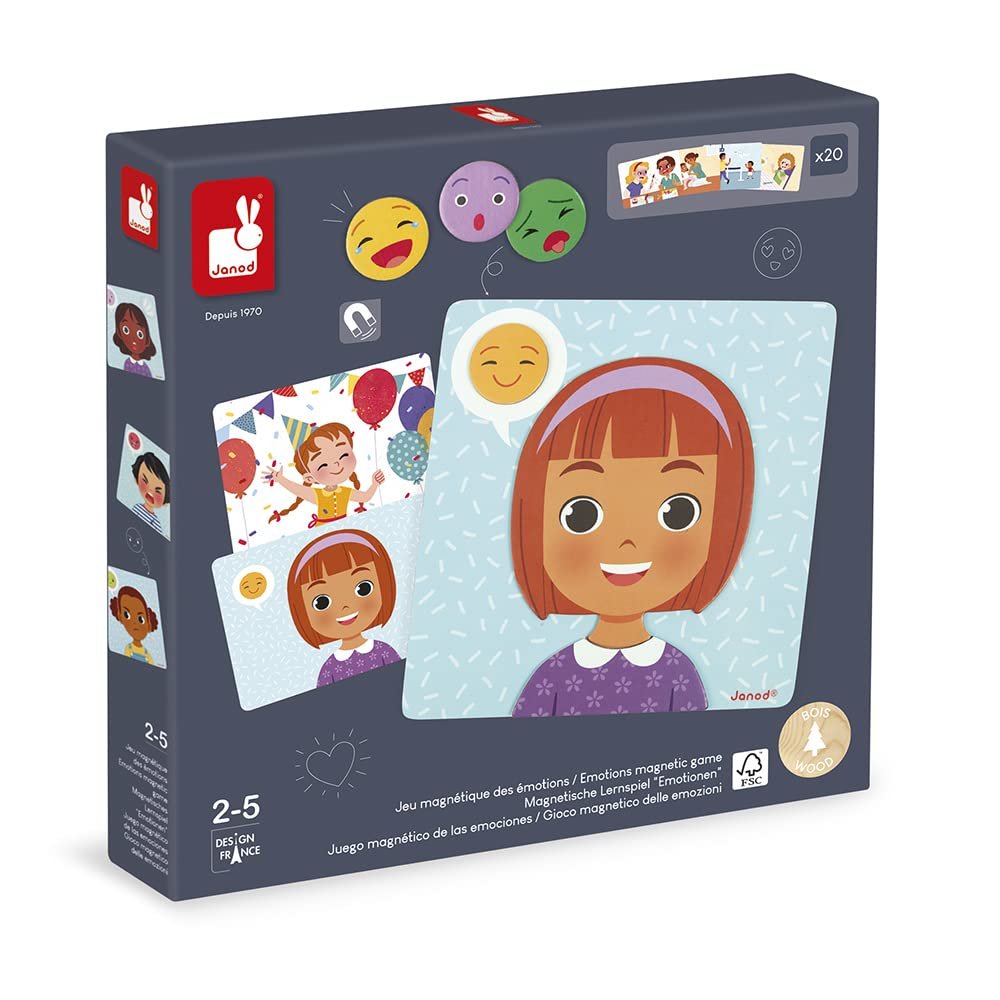
Magnetic Emotions Game
This game is a lovely way to introduce the concepts of emotions to your little one. If they aren’t yet talking in sentences or find understanding longer instructions tricky, don’t worry too much about going full-on with this one but there is no harm in gently introducing the different feelings vocabulary.
I also like the idea of using this almost like a puzzle for really little ones, and just having them stick the magnets on, you can come back to the feelings words later!
*some links are affiliate links which means if you click through and choose to buy I earn a small commission.